

What if the biggest thing blocking your self-love isn’t a lack of discipline… but a belief that you’re a “project” that needs constant fixing?
A lot of us were taught (quietly, over time) that kindness toward ourselves is something we earn.
That we get to feel at home in our own skin after we’re more productive, more healed, more attractive, more impressive, more “together.”
So we become managers of our own worth.
We keep a running list of what needs improvement.
We call it growth.
But there’s a cost to living in “fix-it” mode.
Research has repeatedly linked harsher self-criticism with higher distress and lower well-being, while self-compassion tends to be associated with steadier emotional health and resilience. (Self-Compassion)
This article is about the self-love mindset shift:
Moving from “What’s wrong with me?” to “What’s true for me and how can I support myself as I grow?”.
We’ll reframe perfectionism, soften the inner dialogue, and build a foundation of self-acceptance, self-compassion, emotional resilience, and sustainable personal growth without turning your life into a never ending self-improvement project.
Lets start.

What the Self-Love Mindset Shift Really Means
The self-love mindset shift isn’t a glow-up.
It’s not a new personality.
It’s a change in your starting point.
Fixing mentality vs acceptance and growth mindset
A fixing mindset sounds like:
- “I need to get better before I can relax.”
- “Once I stop doing this, then I’ll finally be proud of myself.”
- “If I’m not improving, I’m failing.”
It can look productive. It can even feel motivating at first. But underneath it often lives a quieter message:
I’m not okay as I am.
An acceptance and growth mindset sounds like:
- “I can be imperfect and still worthy of care.”
- “I can want to grow without hating where I am.”
- “I can support myself through change instead of threatening myself into it.”
Why “fixing yourself” feels productive (but often creates shame loops)
Fixing mode gives you a plan.
It gives you something to do with discomfort.
If you’re feeling insecure, you try harder. If you feel behind, you optimize. If you’re hurting, you attempt to outgrow the pain as quickly as possible.
But shame doesn’t get healed by effort.
It gets reinforced by the belief that you must become someone else to deserve gentleness. And when you inevitably fall short of perfect?
The shame loop tightens:
self-criticism → stress → avoidance or over-control → more self-criticism. (PMC)
The difference between self-improvement and self-abandonment
Here’s a tender question to ask yourself:
Is this change coming from care… or from panic?
Self-improvement rooted in care says:
I matter. I want a life that supports me.
Self-abandonment says:
I’ll be lovable when I’m different.
Sometimes they look identical from the outside. Same habits. Same goals. Same “discipline.”
The difference is internal: one feels steady, the other feels desperate.
What acceptance is (and isn’t)
Acceptance is often misunderstood as:
- “I guess this is just who I am.”
- “Nothing will change.”
- “I’m letting myself off the hook.”
That’s not acceptance. That’s resignation.
Acceptance is simply telling the truth without punishment.
It’s noticing what’s real; your feelings, your patterns, your needs, without turning reality into a verdict about your worth.
Self-love as a practice, not a destination
Self-love isn’t a finish line you cross and then never doubt again.
It’s a daily practice of returning to yourself with honesty and warmth.
A relationship you keep choosing, especially on the days you don’t feel “worthy” of choosing it.

Signs You’re Stuck in the “Fixing Myself” Mode
Sometimes “fixing mode” wears a very convincing disguise.
It can look like ambition.
It can look like high standards. It can even look like “doing the work.”
Here are a few signs the engine underneath might be self-rejection.
1) “I’ll love myself when…”
This is the classic one:
- “When I lose weight.”
- “When I get my act together.”
- “When I stop being so sensitive.”
- “When I finally heal.”
It’s the belief that love is a reward. And it keeps moving the goalpost.
2) Perfectionism and all or nothing behavior
Perfectionism isn’t just “wanting to do well.”
It’s often fear in a tidy outfit.
- If you can do it perfectly, you won’t be criticized.
- If you can be exceptional, you won’t be abandoned.
- If you can stay in control, you won’t be hurt again.
And when perfection isn’t possible (because it isn’t), you either overwork… or shut down.
3) Constant comparison and never feeling “enough”
Even when you’re doing well, it doesn’t land.
You scroll and feel behind.
You achieve and feel unimpressed.
You receive kindness and feel suspicious.
Comparison trains your nervous system to treat other people’s lives as evidence against your own worth.
4) Over-identifying with flaws, mistakes, or labels
You don’t just say, “I made a mistake.”
You say, “I am a mistake.”
Fixing mode turns moments into identities:
- “I’m always like this.”
- “I ruin everything.”
- “I’m not the kind of person who…”
5) Self-care that feels like punishment
Not all “healthy habits” are loving.
If your routine is fueled by disgust, fear, or self-contempt, it might look disciplined but it won’t feel safe.
Self-love doesn’t require softness all the time. But it does require respect.
The Psychology Behind Self-Acceptance and Self-Compassion
You don’t need to know psychology to practice self-love.
But understanding a few basics can make your patterns feel less personal and more… human.
Shame and self-criticism shape identity and behavior
Shame is the feeling that something is wrong with you, not just what you did.
Self-criticism often grows as a strategy: “If I stay on top of my flaws, maybe I’ll prevent rejection.”
It can be an attempt to stay safe.
But harsh self-judgment tends to amplify distress, rumination, and avoidance over time. (PMC)
Self-compassion basics: kindness, common humanity, mindfulness
One widely used definition of self-compassion describes three parts:
- Self-kindness (being supportive rather than harsh)
- Common humanity (remembering you’re not alone in imperfection)
- Mindfulness (noticing pain without exaggerating or suppressing it – Self-Compassion)
It’s not forced positivity.
It’s honest care.
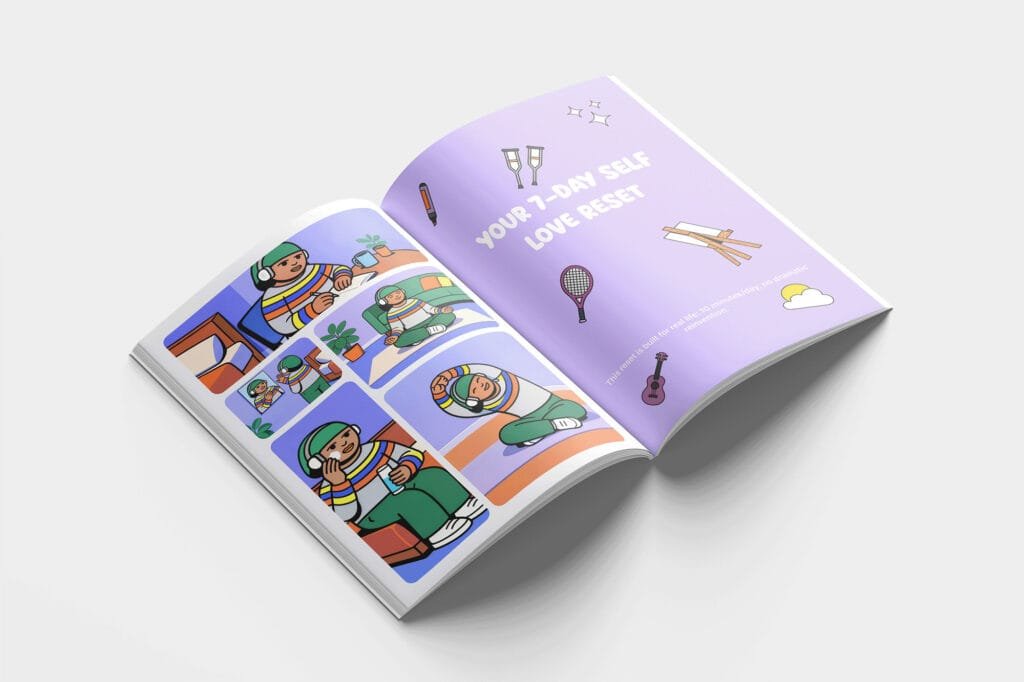
Get your personalized Soft Reset plan in 2 minutes.
Answer a few quick questions and we’ll match you with a gentle plan based on your needs , capacity & vibe so you can feel steadier and build self-trust with small daily steps.
Why compassion can increase motivation (it’s not “letting yourself off the hook”)
A common fear is: “If I’m kind to myself, I’ll stop trying.”
But many studies and reviews have found that self-compassion is often linked with greater resilience after setbacks and healthier persistence; not because it pushes harder, but because it reduces the shame that makes people freeze. (Self-Compassion)
When you’re not spending all your energy fighting yourself, you have more left for change.
A gentle nervous system angle: safety, stress response, regulation
When you speak to yourself with threat (“What is wrong with you?”), your body can respond as if danger is present; tension, urgency, shutdown, spiraling thoughts.
When you speak with support (“Okay. This is hard. I’m here.”), you’re offering a cue of safety.
That doesn’t erase stress, but it can soften the intensity and widen your choices.
This is one reason emotional regulation and nervous system regulation practices often pair naturally with self-compassion:
you’re not just changing thoughts,
you’re changing the tone of your inner environment.
Attachment, inner child patterns, and learned self-worth
A lot of our self-worth is learned in relationships:
How we were responded to when we were messy, sad, loud, needy, proud, scared.
If love felt conditional, it makes sense that adulthood can feel like a performance review.
You don’t have to pathologize your past to notice this:
- What kind of voice did you grow up around?
- What happened when you made mistakes?
- What did you have to do to feel “good enough”?
Self-love is often a form of re-learning. A gentle, steady kind of reparenting—one small moment at a time.

Reframing Self-Talk From Harsh Inner Critic to Supportive Inner Coach
You don’t need to “get rid” of your inner critic overnight.
For many people, that voice shows up because it thinks it’s helping.
A more sustainable approach: listen for the need under the criticism, and respond like a supportive inner coach.
Identify your inner critic scripts (and what triggers them)
Start noticing the repeating lines:
- “You always…”
- “You never…”
- “What’s wrong with you?”
- “If you were better, you would…”
Then notice when they show up:
- After rejection
- During uncertainty
- When you’re tired
- When you’re visible (posting, presenting, dating, applying)
This isn’t about self-blame.
It’s about pattern recognition.
Swap judgment for curiosity
A powerful pivot is moving from evaluation to inquiry:
- “Why am I like this?” → “What’s happening for me right now?”
- “I’m so lazy.” → “What feels heavy or unclear?”
- “I’m a mess.” → “What do I need support with?”
Try this one question: “What am I needing right now?”
Not to fix. To meet.
Practical reframe examples
Work
- Critic: “You’re behind. You’re embarrassing.”
- Coach: “You’re overwhelmed. Let’s choose one small next step.”
Relationships
- Critic: “You’re too much. Stop needing things.”
- Coach: “Your needs matter. Let’s name them clearly and kindly.”
Body image
- Critic: “You look terrible.”
- Coach: “You’re having a hard body day. Can we shift to neutrality: ‘This is my body today.’”
Failure
- Critic: “You ruined everything.”
- Coach: “You’re learning. Let’s repair what we can, and rest.”
Language upgrades that change everything
Small words carry big emotional weight.
- “Should” → “Could”
- “I have to” → “I’m choosing to”
- “I’m wrong” → “I’m learning”
- “This is a disaster” → “This is uncomfortable”
- “I can’t” → “This is hard for me right now”
This is positive self talk that doesn’t feel fake. It’s supportive realism.
Micro-practices you can use in 60 seconds
1) The self-compassion pause
- Put a hand on your chest or belly (optional, but grounding).
- Breathe once, slower than usual.
- Say: “This is hard.” (mindfulness)
- Say: “I’m not alone in this.” (common humanity)
- Say: “May I be kind to myself right now.” (Self-Compassion)
2) Name-and-normalize
- “I’m spiraling.”
- “That makes sense—this is a tender spot.”
- “I can take one kind step.”
You’re not trying to become unbothered. You’re practicing coming home.

Join the Waitlist
A kinder inner voice, daily.
Nostalgie World is a story-driven well-being brand that invites you into a gentle daily practice of reflection; through nostalgic characters, guided journaling, and emotionally safe rituals designed to foster self-compassion in just a few minutes a day.
No pressure.
No streak shame.
No clinical language.
Just a small moment of care, whenever you need it.
Acceptance That Fuels Growth (Not Stagnation)
Here’s the paradox: acceptance is often what makes change possible.
Because when you stop fighting your own humanity, you stop wasting energy on shame.
“Accepting where I am” is the starting line
Acceptance says:
- “This is where I am today.”
- “This is what I feel.”
- “This is what I did.”
- “This is what I need.”
No drama. No punishment. Just clarity.
And clarity is powerful.
Growth rooted in values instead of insecurity
Insecurity asks: How do I prove I’m enough?
Values ask: What kind of person do I want to be? What matters to me?
Values-based living is steadier than self-esteem because it’s not as dependent on mood or comparison.
When you choose growth from values, you’re not chasing worthiness. You’re practicing alignment.
Goals without tying them to worthiness
It’s okay to want things:
- More stability
- Healthier habits
- Better boundaries
- Stronger relationships
- New skills
The shift is this: Your goals are not evidence that you’re currently unworthy.
They’re simply directions you’d like to move in.
Process goals and identity-aligned habits
Instead of “I need to lose 10 pounds,” you might choose:
- “I want to feel more connected to my body.”
- “I want to move in a way that supports my energy.”
- “I want to feed myself with respect.”
Instead of “I need to be more confident,” you might choose:
- “I want to practice self-trust in small decisions.”
- “I want to speak to myself more kindly.”
This is identity based habits in a compassionate form: not “become perfect,” but “become supportive.”
Self-trust as the real metric of progress
A quiet way to measure growth:
- Do you come back to yourself faster after hard moments?
- Do you recover from mistakes with less self-attack?
- Do you keep promises to yourself more gently?
Self-trust builds when you stop abandoning yourself mid-struggle.

Practical Tools to Build the Self-Love Foundation Daily
Self-love doesn’t have to be dramatic. It can be small and ordinary; like water.
Read more about Journaling for Beginners.
Daily self-love check-in (feelings, needs, next kind step)
Try this once a day (even in your head):
- What am I feeling right now?
- What do I need?
- What’s one kind step I can take next?
Kind step doesn’t mean “big fix.” It might be:
- Drink water
- Step outside for two minutes
- Send one email
- Eat something with protein
- Text a safe friend
- Close one tab
- Rest without negotiating
Journaling prompts for the mindset shift
- “Where am I treating myself like a problem to solve?”
- “What would support look like today instead of pressure?”
- “What’s one belief I’m ready to soften?”
- “If I didn’t have to earn love, what would I do differently?”
- “What’s a kind truth about me that I keep forgetting?”
Boundaries as self-love (saying no without guilt)
Boundaries aren’t walls. They’re clarity.
A gentle script:
- “I can’t do that, but thank you for thinking of me.”
- “That doesn’t work for me.”
- “I’m not available for that.”
- “I need to take care of my capacity right now.”
If guilt shows up, you don’t have to argue with it.
You can simply remind yourself:
“Guilt doesn’t always mean I’m doing something wrong. Sometimes it means I’m doing something new.”
A self-care menu: rest, play, movement, connection, solitude
Instead of “self-care routines” that feel like chores, try a menu you can choose from depending on your day:
- Rest: nap, early bedtime, quiet room, slow morning
- Play: music, dancing, games, silly videos, creative hobbies
- Movement: stretch, walk, yoga, gentle strength, shaking out tension
- Connection: text a friend, sit with someone, voice note, community space
- Solitude: phone down, journaling, tea, a long shower, a solo date
Self-care habits work better when they fit your actual life; not an ideal version of you.
“Repair over perfection”: coming back after setbacks
Setbacks aren’t proof you failed. They’re part of being human.
Repair can look like:
- “Okay. That happened. What do I need now?”
- “What’s the smallest reset available?”
- “How can I be on my own side again?”
This is how a self love routine becomes sustainable: not perfect days, but reliable returns.
Healing the Root Belief of “I’m Not Enough”
If “fixing mode” has a root, this is often it:
The belief that you are fundamentally not enough.
It can be loud or quiet.
It can hide behind humor, achievement, people-pleasing, or overthinking.
Where the belief can come from (without blaming your past)
Sometimes it’s conditioning:
- praise only when you performed
- criticism that outweighed warmth
- comparisons that felt constant
- environments where emotions were inconvenient
Sometimes it’s later experiences:
- rejection
- betrayal
- bullying
- relationships that made love feel conditional
You don’t have to map every detail to begin unlearning the belief. You just need to notice when it’s speaking.
Separating identity from performance
You are not your productivity. You are not your worst moment.
You are not the version of you that shows up when you’re triggered, tired, or scared.
A helpful reframe: “My performance is information. My worth is not up for debate.”
Evidence-building: collecting proof of competence and resilience
If your brain is trained to collect evidence of failure, you can gently train it to collect evidence of survival.
Try keeping a small list called: “Proof I can handle things.”
Include:
- times you recovered
- hard conversations you had
- boundaries you set
- ways you kept going
- moments you chose kindness over collapse
This isn’t bragging. It’s balancing the story.
Self-forgiveness (what it is, what it isn’t)
Self-forgiveness is not:
- pretending it didn’t happen
- avoiding responsibility
- forcing yourself to “move on” fast
Self-forgiveness is:
- taking responsibility without self-hate
- letting yourself learn without lifelong punishment
- choosing repair where possible
Compassionate accountability: responsibility without self-attack
Accountability can sound like:
- “That wasn’t aligned. I want to do better.”
- “I see the pattern. I’m willing to practice a new response.”
- “I can make amends without shaming myself into change.”
This is kind discipline: firm, loving, realistic.

Mindset Shift Examples (Real-Life Scenarios and Better Reframes)
Sometimes the shift becomes real when you can hear it.
After a mistake: shame spiral vs learning response
Shame spiral: “I’m so stupid. I always mess things up.”
Better reframe: “I made a mistake. I can repair what I can, learn what I need, and keep going.”
Body image day: critique vs appreciation and neutrality
Critique: “I look awful. I can’t be seen like this.”
Better reframe: “I’m feeling tender about my body today. I can practice body neutrality: this is my body, and it deserves care.”
Conflict or rejection: personal defect vs mismatch and growth
Defect story: “They didn’t choose me because I’m not enough.”
Better reframe: “This hurts. It might be a mismatch, timing, or preferences; none of which define my worth. I can grieve and still respect myself.”
Procrastination: laziness label vs overwhelm insight
Label: “I’m lazy. I have no discipline.”
Better reframe: “I’m overwhelmed, unclear, or scared. What’s the smallest step that feels doable? What support would help?”
Relapse into old habits: failure story vs data and repair
Failure story: “See? I never change.”
Better reframe: “Old patterns showed up. That’s data, not a verdict. What triggered this? What’s one gentle repair I can do today?”
This is break the shame spiral energy: not dramatic, just steady.
How to Keep the Shift Going Long-Term
This isn’t a one-time breakthrough.
It’s a practice you return to, especially when life gets loud.
Progress markers that matter
Instead of looking for “constant confidence,” look for:
- less self-attack after mistakes
- quicker emotional recovery
- stronger boundaries
- fewer all or nothing swings
- more honesty with yourself
- more willingness to rest without guilt
These are signs of a healthier inner relationship.
Build a supportive environment (people, media diet, routines)
Your nervous system learns from what it’s around.
Consider:
- Who makes you feel safe to be imperfect?
- What content makes you feel “behind” or “not enough”?
- What routines help you return to yourself?
A small media diet shift can be a self-love habit:
- mute accounts that spike comparison
- follow voices that feel grounded and human
- take breaks that help your body exhale
When to seek support
If you feel stuck in a shame cycle, or your inner critic feels relentless, support can be deeply helpful.
That might look like:
- therapy
- coaching
- support groups
- trusted mentors
- somatic or mindfulness-based classes
Needing support doesn’t mean you failed.
It means you’re human and you care about your healing.
Create a personal mantra and a “compassion plan” for hard days
A mantra isn’t magic.
It’s a reminder you can reach for when you can’t think clearly.
Examples:
- “I can be kind and still grow.”
- “I’m allowed to be a work in progress.”
- “This is hard, and I can support myself.”
A simple compassion plan:
- one person you can reach out to
- one grounding practice (walk, shower, breath)
- one “minimum viable” task list for the day
- one kind sentence you’ll return to
Maintenance habits: weekly reflection, monthly reset, realistic pacing
Try a gentle rhythm:
- Weekly reflection: What drained me? What nourished me? What do I need more of?
- Monthly reset: What do I want to release? What do I want to protect?
- Realistic pacing: growth that doesn’t require self-betrayal
Because the goal isn’t to become someone else.
It’s to become someone who stays.
Conclusion
The truth is, you don’t need to become “fixed” to be worthy of love.
You need to become present with yourself, then choose growth from a place of self-acceptance, self-compassion, and aligned intention.
If you take one thing from this guide, let it be this:
Growth works best when it’s rooted in care, not criticism.
Start small today by trying one reframe, one boundary, one compassionate check-in.
You’re not a project.
You’re a person.
And you’re allowed to grow without abandoning yourself along the way.