
“Write three pages longhand, stream of consciousness, first thing in the morning.”
That gentle but firm instruction from Julia Cameron in her book The Artist’s Way has shaped the creative lives of millions.
The Morning Pages Guide isn’t about writing beautifully. It’s not about being insightful. It’s not even about being coherent.
It’s about honesty.
Morning Pages are about taking the noise that wakes up with you; the worries, the half-formed ideas, the resentment, the grocery list, the dream fragments.. and letting it spill onto paper before the world gets a vote.
Research on expressive writing, pioneered by psychologist James Pennebaker, suggests that putting thoughts and feelings into words can support emotional processing and reduce stress over time.
Other studies have found that writing about experiences may help people organize their thinking more clearly and make meaning from what feels chaotic.
It’s not magic.
But it is powerful.
Morning Pages are simple.
And sometimes, simple practices are the ones that quietly change us.
Let’s walk through what the morning pages method really is, why free-writing mornings can feel like a mental reset, and how to begin in a way that feels sustainable.. not performative.

What Are Morning Pages? (Understanding the Free-Writing Practice)
At its core, the morning pages method is beautifully uncomplicated:
- Three pages
- Written longhand
- First thing in the morning
- Stream of consciousness
- No editing
- No censoring
That’s it.
Origins in The Artist’s Way
Julia Cameron introduced this practice as a foundational exercise in The Artist’s Way writing exercise.
Her belief was that creativity gets blocked not because we lack talent, but because we’re crowded with inner noise.
Morning Pages clear the channel.
How It Differs From Traditional Journaling
Morning Pages are not:
- Gratitude lists
- Structured prompts
- A recap of yesterday
- A productivity planner
They’re closer to brain dump journaling; a raw mental decluttering process.
In structured vs unstructured journaling terms, this sits firmly in the unstructured camp.
There’s no theme. No performance. No goal.
Just movement.
Why Handwriting Matters
The longhand writing practice is intentional.
Research into handwriting suggests that writing by hand engages the brain differently than typing.
Some studies indicate it may encourage deeper processing and memory integration.
There’s also something grounding about the physicality, pen dragging across paper, ink soaking in.
(my favorite ritual is using my pink fountain pen and my daily journaling notebook)
Typing invites editing. Handwriting invites honesty.
Common Misconceptions
- You don’t have to be a “creative.”
- You don’t have to write well.
- You don’t have to feel inspired.
- You don’t have to reread what you wrote.
Morning Pages are not a writing therapy technique.
They’re a daily self-discipline practice of emptying your mind before the world fills it.
The Science Behind Free-Writing Mornings
The expressive writing benefits have been studied for decades.
Research suggests that writing about thoughts and emotions can:
- Reduce stress responses over time
- Support emotional regulation
- Improve cognitive clarity
- Help organize overwhelming experiences
Some studies even suggest expressive writing may be associated with lower stress hormone activity and improved immune markers in certain contexts.
The effects vary by individual, and it’s not a replacement for professional care, but the pattern is consistent:
Writing can help us process.
The Brain-Dump Effect
When you wake up, your mind is already active.
Unfinished conversations.
Future worries.
Creative sparks.
Morning Pages function as brain decluttering techniques. Instead of carrying mental tabs all day, you close them early.
Think of it as a mental reset morning ritual.
Creativity & Neuroplasticity
Creative insight often emerges when the mind is allowed to wander freely.
Stream of consciousness writing creates that space. You’re not forcing ideas; you’re uncovering them.
Many people find Morning Pages become a creative block solution not because they try harder, but because they stop trying at all.
The Power of Routine
There’s also the psychological stability of ritual.
A consistent morning journaling routine signals safety to the nervous system.
The predictability itself can be calming. Over time, it becomes a morning focus habit… not dramatic, just steady.

Step by Step: How to Start Morning Pages in 2026
You don’t need a perfect notebook.
You don’t need aesthetic pens.
(but personally, I enjoy them)
You just need to begin.
Step 1: Write Immediately After Waking
Before emails.
Before scrolling.
Before conversation.
Your mind is softer then. Less filtered.
Step 2: Use Pen and Paper
No editing.
No backspace.
No distractions.
Handwritten journaling slows you down in the best way.
Step 3: Fill Three Pages
Not one.
Not “until you feel done.”
Three full pages. Even if the last half-page says, “I don’t know what to write.”
Especially then.
Step 4: Don’t Reread (At First)
This isn’t content. It’s clearing.
You can revisit weeks later if you want perspective. But daily rereading invites judgment.
Step 5: Make It Gentle but Non-Negotiable
Consistency matters more than brilliance.
Most people take 20–30 minutes. If three pages feel overwhelming, start with two, then build.
If you’re stuck, try:
- “Right now I’m feeling…”
- “What’s bothering me is…”
- “If I were completely honest…”
Let it be messy.

Powerful Benefits of Morning Pages
People often describe similar shifts over time:
- Mental clarity exercises that make decisions feel simpler
- Less rumination and overthinking
- Creative breakthroughs that arrive unexpectedly
- Increased productivity and focus
- Greater emotional processing through writing
- Stronger self-awareness exercises
- A quieter inner critic
Morning Pages won’t eliminate stress. But they can make stress less tangled.
They create space between you and your thoughts. And space changes everything.

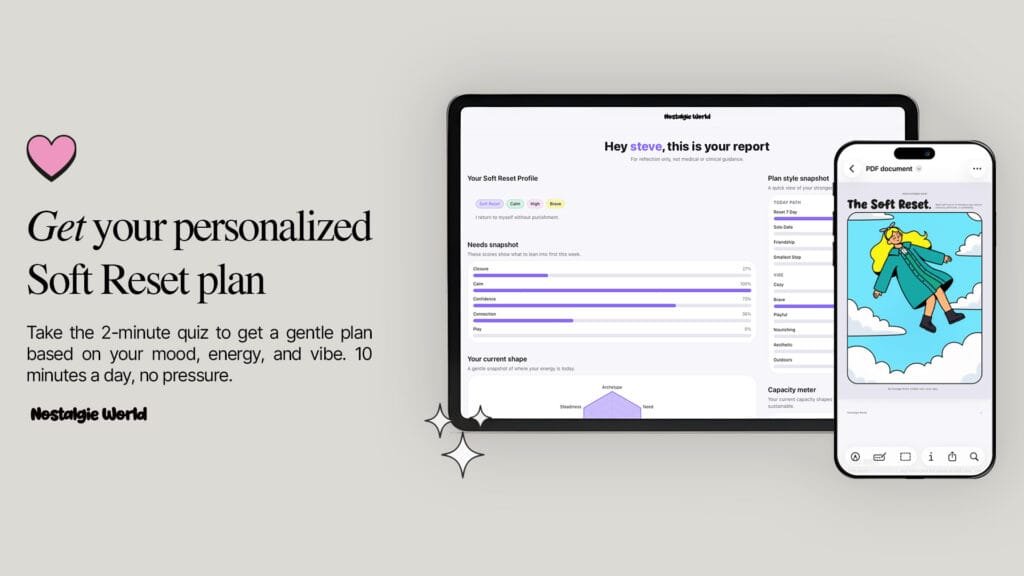
Get your personalized Soft Reset plan in 2 minutes.
Answer a few quick questions and we’ll match you with a gentle plan based on your needs , capacity & vibe so you can feel steadier and build self-trust with small daily steps.
Common Mistakes to Avoid with Morning Pages
Even simple practices can get complicated.
Here’s what tends to derail people:
- Editing or trying to sound profound
- Skipping frequently and restarting dramatically
- Turning it into a to-do list
- Overanalyzing every sentence
- Using digital devices and drifting into distraction
- Expecting instant transformation
This is a daily mental clarity habit, not a miracle.
Some days will feel powerful. Some days will feel boring. Both count.
Join the Waitlist
A kinder inner voice, daily.
Nostalgie World is a story-driven well-being brand that invites you into a gentle daily practice of reflection; through nostalgic characters, guided journaling, and emotionally safe rituals designed to foster self-compassion in just a few minutes a day.
No pressure.
No streak shame.
No clinical language.
Just a small moment of care, whenever you need it.
Morning Pages vs. Journaling vs. Gratitude Writing
Morning Pages
- Unstructured
- Three pages
- Brain dump
- Focused on clearing
Traditional Journaling
- Reflective
- Often prompt-based
- Can be structured
Gratitude Writing
- Intentionally positive
- Focused on appreciation
If you’re comparing journaling vs Morning Pages, the difference is purpose.
Morning Pages clear.
Journaling reflects.
Gratitude writing uplifts.
They can absolutely coexist. Some people brain dump first, then list gratitudes. Others separate them entirely.
Your personality matters.
Analytical thinkers may love the mental organization. Creatives may love the free writing technique.
Highly structured personalities might need to resist turning it into productivity tracking.
Let it fit you, not the other way around.

How to Turn Morning Pages Into a Lifelong Habit
Habits don’t stick through intensity.
They stick through rhythm.
Habit Stacking Writing
Pair it with something you already do:
- After brushing your teeth
- While drinking coffee
- Before checking your phone
Create a Dedicated Space
A small corner.
A specific chair.
A consistent pen.
Repetition builds familiarity.
Track Without Pressure
You can mark days in a calendar. But avoid streak anxiety.
If you miss a day, resume gently.
No guilt. Just return.
When Will You See Results?
Some people feel clearer within days. For others, it’s subtle and cumulative.
The deeper change is less about productivity habits or trends, and more about relationship.
You begin relating to your mind differently.

Who Should (and Shouldn’t) Do Morning Pages?
Morning Pages can support:
- Creatives navigating blocks
- Entrepreneurs managing idea overload
- Students juggling mental clutter
- Knowledge workers seeking morning brain optimization
- Anyone wanting a morning self-care practice rooted in honesty
If you’re experiencing intense emotional distress or trauma, professional therapy may be more appropriate support.
Morning Pages are reflective, not a substitute for clinical care.
If three pages feel impossible with your schedule, adapt:
- Two pages
- 10 minutes
- Even one page consistently
Flexibility builds sustainability.
Conclusion
Morning Pages aren’t glamorous.
No one applauds you for filling three pages at dawn.
But something subtle happens when you practice this daily creative discipline. The mind softens. Thoughts organize themselves. Decisions feel less reactive.
Free-writing mornings build clarity. Clarity builds focus. Focus builds momentum.
And momentum, built gently, changes lives.
Tomorrow morning, before the world begins asking things of you, open a notebook.
Three pages. No editing. No judgment.
Just you; meeting yourself honestly on paper.
And that alone is a powerful place to begin.
Frequently Asked Questions (FAQ)
What exactly are Morning Pages (and how are they different from journaling)?
Morning Pages are a daily free-writing practice popularized by Julia Cameron: three pages of stream-of-consciousness writing, usually first thing in the morning. The goal isn’t a “dear diary” recap or polished reflection, but to empty mental noise onto the page so you can think more clearly and create more freely.
Do Morning Pages have to be handwritten, or can I type them?
The traditional method is longhand (pen and paper). Cameron has repeatedly emphasized handwriting; many practitioners feel it slows you down in a good way and reduces the “edit as you go” impulse. That said, plenty of people do type when handwriting isn’t practical; the key is keeping it uncensored and distraction-free.
Do I really have to write three pages every day? What if I don’t have time?
The classic guideline is three pages, not because it’s magic, but because it often takes a page or two to “clear the junk” before the useful stuff shows up. If you’re pressed for time, a common approach is: do what you can, but keep the habit alive (even a shorter session), then return to the full three pages when your schedule allows.
What should I write about if I have nothing to say?
Anything. Seriously. Write: “I don’t know what to write,” then keep going. Many Morning Pages guides (and community summaries of Cameron’s approach) explicitly recommend writing whatever crosses your mind from complaints, worries, to random observations, or even boredom because the practice works by removing the filter.
Should I reread my Morning Pages or keep them private?
Most Morning Pages advice says keep them private and don’t reread right away, at least early on. The reason is simple: rereading too soon can wake up your inner editor and make you self-censor tomorrow. Some people eventually review entries later (weeks/months) to notice patterns, but “privacy first” is the standard recommendation