

Ever notice how your brain can hold everything… except clarity?
Somewhere between the unread messages, the half-felt feelings, and the “I’m fine” you keep handing out like a flyer, your inner world gets noisy.
That’s where journaling and reflection quietly changes the game.
Not in a dramatic, “new life by Monday” kind of way.
More like this: you put a few honest lines on the page (or in your notes app), and suddenly your day has edges. Shape. Meaning.
You stop carrying the whole thing in your chest.
A gentle journaling system doesn’t just help you vent.
It can support emotional wellbeing, soften mental clutter, and make your next step feel a little more obvious, without turning your life into a project.
This guide is for the real version of journaling:
The kind that fits on busy days, wobbly days, and “I don’t even know what I feel” days.
You’ll find prompts, formats you can copy, reflection frameworks, and a calm, doable soft reset plan you can return to anytime.
Why Journaling & Reflection Works for Emotional Wellbeing
There’s something quietly stabilizing about putting feelings into words.
When you write, you’re not just documenting your life, you’re meeting it.
You’re making space for what’s true, even if it’s messy.
And in that space, self-awareness grows.
How journaling supports emotional regulation and self-awareness
A feelings journal (or even a quick emotional check-in) gives your emotions somewhere to land.
Instead of trying to manage everything internally, you externalize it.
You create a little distance, enough to breathe.
You might notice:
- patterns in your mood (hello, mood tracking journal)
- what you do when you’re stressed
- what you avoid when you’re overwhelmed
- what you actually need (not what you think you should need)
This is the heart of self awareness journaling: less “fix me,” more “know me.”
Reflection vs. rumination: how to journal without spiraling
Reflection helps you understand.
Rumination keeps you stuck.
A simple way to tell the difference:
- Reflection sounds like: “What’s happening here? What matters? What do I need?”
- Rumination sounds like: “Why am I like this? What if it never changes? What did I do wrong?”
If your journaling for anxiety or overwhelm tends to spiral, you don’t need to “try harder.” You just need gentler structure.
Try this “stop rule”:
If you’ve written the same fear three times, pause. Switch to the body. Switch to needs. Switch to one small next step.
(You’ll find grounding prompts later.)
The “clarity loop”: feelings → words → meaning → next action
Here’s the loop that makes reflection journaling so useful:
Feelings → Words → Meaning → Next Action
- Feelings: Something is going on.
- Words: Here’s what it sounds like in my head.
- Meaning: Here’s what I think this is really about.
- Next action: Here’s one gentle thing I can do.
Not a big overhaul. Just a tiny return to agency.
What to expect in the first 7 days (and why consistency beats intensity)
The first week of journaling for emotional wellbeing often looks like this:
- Day 1–2: mental declutter (lots of “ugh” and “I didn’t realize…”)
- Day 3–4: patterns start showing up
- Day 5–7: you begin naming needs and making calmer choices
You don’t need long, perfect entries.
A two minute journaling habit can build more trust with yourself than a once-a-month emotional deep dive.
Consistency isn’t about discipline.
It’s about making it easy enough that you’ll come back.

Choose Your Journaling Style: Prompts vs. Freewriting vs. Structured Templates
If you’ve tried journaling and bounced off it, it might not be “you.”
It might be the format.
Different seasons call for different methods.
Let’s make that allowed.
Prompted journaling: best for decision fatigue and “I don’t know what to write”
Guided journaling is like a hand on the railing. You don’t have to invent the path, you just answer one question at a time.
Prompted journaling works well if you:
- feel blank when you open a notebook
- get overwhelmed by “start anywhere”
- want daily journaling prompts that feel contained
This is also great for journaling for beginners who want a gentle entry point.
Freewriting: when you need emotional release and creative flow
Freewriting is the brain dump journal’s older sibling.
You write whatever comes, without editing.
Spelling doesn’t matter.
Logic doesn’t matter.
You’re not performing clarity; you’re letting it arrive.
Freewriting helps when:
- emotions are stuck in your body
- you feel restless, buzzy, or overloaded
- you need expression more than insight
If you tend to overthink, freewriting can be a relief.
If you tend to spiral, add a timer (5–10 minutes) and finish with one grounding line: “Right now, I’m safe enough to breathe.”
Structured templates: best for habit-building and measurable progress
Structured journaling is soothing if you like a simple system and repeatable prompts.
Templates can support habit building journaling because you don’t have to decide what to do every time.
This is especially helpful for:
- a journaling routine
- a minimum viable journal
- tracking patterns without turning it into a chore
Quick quiz: which journaling style fits your personality and goals?
Pick the statement that feels most true right now:
- “I’m tired and I don’t want to think.” → Choose prompted journaling.
- “I have too much inside me and I need it out.” → Choose freewriting (with a timer).
- “I want something simple I can repeat daily.” → Choose structured templates.
- “I like options, but I need a container.” → Mix: one prompt + a short freewrite + a one-line close.
You’re allowed to change your style as your season changes.
The Best Journaling Formats (With Examples You Can Copy)
Below are journaling templates and journaling formats you can copy into a notebook, notes app, or journaling app.
Morning pages (mental declutter)
This is classic morning pages energy:
You write to clear the fog, not to create a masterpiece.
Format (5–10 minutes):
- What’s on my mind:
- What I’m carrying from yesterday:
- What I’m nervous about:
- What I want to feel today:
- One tiny intention:
Optional close: “If today is messy, I can still be kind to myself.”
Evening reflection (closure and nervous system downshift)
Night journaling can help your brain stop trying to solve life at 1:12 a.m.
Evening reflection prompts (3–5 minutes):
- What did I do well today (even small)?
- What felt heavy?
- What helped, even a little?
- What can wait until tomorrow?
- One gentle thing I’m grateful for (hello, gratitude journaling).
If gratitude prompts feel forced, keep it honest: “I’m grateful for the shower.” “I’m grateful I made it through.”
One line a day (tiny habit, big pattern recognition)
A one line a day journal is the opposite of pressure. It’s also surprisingly revealing over time.
Format:
- Today felt like:
- One thing I learned about myself:
- A word for my mood:
You’ll start noticing patterns without needing to “process everything.”
Voice journaling (for people who hate typing)
Voice journaling counts. Full stop.
Try this if you:
- process better out loud
- feel blocked by the page
- want journaling for overwhelm that feels effortless
Voice prompt (2–4 minutes):
- “Here’s what I’m feeling…”
- “Here’s what I wish someone understood…”
- “Here’s what I need next…”
If privacy is a concern, summarize afterward with one sentence you can keep: “Today’s theme: I need rest and clarity.”
“Two-column” journaling: thoughts vs. truths
This is a gentle thought journal format that helps you hear yourself without believing every thought.
Draw a line down the page:
Left column: What my mind says Right column: What else might be true
Example:
- Mind: “I’m behind and everyone knows.”
- Truth: “I’m tired. I’m learning. I’m allowed to be human.”
This can support self compassion journaling and inner critic journaling without arguing with yourself.
Guided check-in template (mood, body, needs, next step)
This is one of my favorite daily check-in templates, especially for emotional processing.
Copy/paste:
- Mood (0–10):
- Body (what do I notice?):
- What emotion is asking for attention?:
- What do I need (really)?:
- One next gentle step:
- One sentence of kindness to myself:
If you only do one thing, do the last line.

Journaling Prompts for a Soft Reset (Not a Total Life Overhaul)
A soft reset plan isn’t a glow-up. It’s a return.
A quiet recalibration.
These prompts are designed for stress relief journaling, emotional clarity, and coming back to yourself without pressure.
Reset prompts for stress and overwhelm
- What feels like too much right now?
- If I could set one thing down for 24 hours, what would it be?
- What’s one place I can make today 5% lighter?
- What would “enough” look like today?
Prompts for emotional clarity (“what am I actually feeling?”)
If you can’t name it, start here:
- If my emotion had a color or weather, what would it be?
- What happened right before I started feeling this way?
- What am I telling myself about what it means?
- What’s the feeling underneath the feeling?
Identity prompts (“what do I want to return to?”)
This is gentle identity journaling, not a reinvention:
- When do I feel most like myself?
- What parts of me have been quiet lately?
- What do I miss about the way I used to live?
- What do I want to protect in myself this year?
Boundary prompts (where you’re leaking energy)
For boundary journaling and self-respect:
- Where am I saying yes to avoid discomfort?
- What do I resent right now (and what is it pointing to)?
- What am I responsible for… and what am I not?
- What needs a limit, not more effort?
Self-compassion prompts (when you feel behind)
For days when shame gets loud:
- If someone I loved felt this way, what would I say to them?
- What would it mean to treat myself like I’m on my own side?
- What’s a kinder explanation for why this is hard?
- What have I survived that I forget to credit myself for?
“Next gentle step” prompts (action without pressure)
This is decision making journaling without intensity:
- What’s the smallest next step that would help?
- What’s one choice that supports my future peace?
- What can I do in 10 minutes that my nervous system would like?
- If I couldn’t fix it today, what could I support?
Journaling Systems That Actually Stick (7, 14, and 30-Day Options)
A journaling system works when it respects your real life.
Below are three options: a 7 day journaling challenge, a 14-day pattern breaker, and a 30-day emotional wellbeing plan.
Each one is designed to feel doable, not dramatic.
The 7-day soft reset system (simple, beginner-friendly)
Goal: settle mental noise and re-orient gently.
Daily (5 minutes):
- Mood and body check-in (2 lines)
- One prompt (choose from the soft reset prompts above)
- “Next gentle step” (one sentence)
Theme by day:
- Day 1: Where am I right now?
- Day 2: What’s heavy?
- Day 3: What do I need?
- Day 4: What’s within my control?
- Day 5: What am I avoiding (gently)?
- Day 6: What would support me?
- Day 7: What do I want to carry forward?
This is a life reset journal approach, but soft enough to actually return to.
The 14-day “pattern breaker” system (habits and mindset)
Goal: notice patterns and practice small reframes.
Daily (6–8 minutes):
- A short check-in template
- One “two-column” thought vs. truth entry
- One self-compassion close
Add-on (every 3rd day):
- “What keeps repeating?”
- “What’s the need beneath it?”
- “What boundary or support would help?”
This supports mindset journaling and reframing prompts without becoming harsh.
The 30-day emotional wellbeing system (themes + tracking)
Goal: steady self-awareness + gentle structure.
Pick a weekly theme:
- Week 1: emotional clarity (name feelings, notice triggers)
- Week 2: energy restoration (rest, nourishment, nervous system soothing)
- Week 3: boundaries + values (self-respect, alignment)
- Week 4: identity + direction (what you’re returning to)
Daily (5 minutes):
- mood rating (0–10)
- one sentence: “Today’s emotional weather…”
- one prompt from the week’s theme
- one micro-action
Optional tracking (no pressure):
- sleep quality (simple: low / okay / good)
- energy (low / medium / high)
- one “helped today” note
This gives you the benefits of a mood tracking journal without turning your feelings into a performance.
How to create a “minimum viable journal” (2 minutes/day)
If you only have two minutes, do this:
- Right now, I feel…
- What I need is…
- One small support I can give myself is…
That’s it. That’s a journal habit.
What to do when you miss a day (no shame, just a restart rule)
Missing a day doesn’t mean you “fell off.” It means you’re human.
Try this restart rule:
Never “catch up.” Just begin again. Write one line: “I’m back.”
Consistency is built by returning, not by being perfect.

Reflection Frameworks to Turn Insight Into Change
Sometimes journaling feels good… but nothing shifts.
That’s usually not because you’re doing it wrong.
It’s because the reflection needs a bridge to action.
These frameworks help you gently cross that bridge.
The “Name it → Normalize it → Navigate it” method
This is simple and emotionally safe.
- Name it: What am I feeling (as accurately as I can)?
- Normalize it: Why would this make sense, given what I’ve lived or what’s happening?
- Navigate it: What’s one kind response or next step?
Example:
- Name it: “I feel rejected.”
- Normalize it: “I was left out. Of course that stings.”
- Navigate it: “I’ll text a friend and make one plan that includes me.”
CBT-style thought journaling (situation → thought → feeling → alternative thought)
This is often called CBT journaling or a cognitive reframing journal format.
You don’t need to “fix” your thoughts… just widen the lens.
Copy this:
- Situation:
- Thought:
- Feeling:
- Alternative thought (more balanced):
- One supportive action:
Keep the alternative thought believable.
Not sunshine. Just steadier.
Instead of: “Everything is amazing.”
Try: “This is hard, and I can take one step.”
Values-based reflection (choices aligned with what matters)
Values journaling helps when you’re stuck in people-pleasing, indecision, or burnout.
Prompts:
- What matters most to me in this season?
- What choice would support that value (even 5%)?
- Where am I living out of fear instead of meaning?
- What would self-respect look like today?
Values don’t demand perfection. They offer direction.
The “3R” framework: Recognize, Reframe, Respond
This is great for journaling for burnout and stress patterns.
- Recognize: What’s the pattern or trigger?
- Reframe: What’s another way to interpret this?
- Respond: What’s one action that supports future peace?
You’re not trying to become unbothered. You’re practicing steadier responses.
Weekly review prompts that produce real decisions
A weekly reflection or weekly review journaling ritual can keep your growth gentle and real.
Try this once a week (10 minutes):
- What gave me energy?
- What drained me?
- What did I avoid (and why)?
- What boundary would help next week?
- What do I want to do differently—specifically?
- One decision I’m making for my wellbeing:
Small decisions, made consistently, change lives quietly.
Build Your Personalized Soft Reset Plan (Web-to-App Funnel Section)
Sometimes the hardest part of journaling isn’t writing.
It’s deciding what kind of journaling will actually help you today.
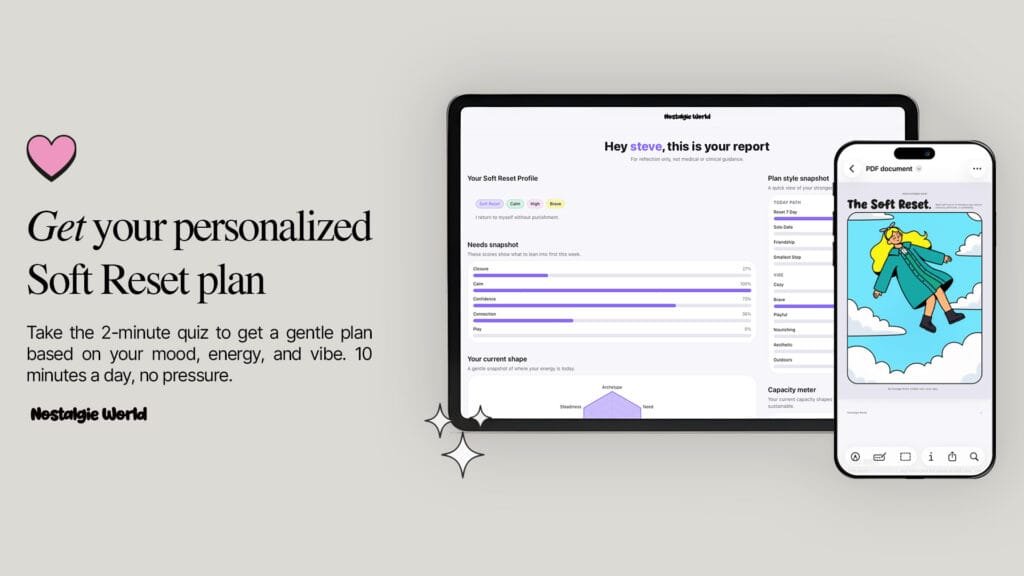
That’s where a personalized journaling plan can be genuinely supportive, especially if you’re tired, overwhelmed, or trying to build a routine that sticks.
What a personalised soft reset plan is (and why personalization matters)
A personalised soft reset plan is a simple, tailored guide that helps you:
- find the right journaling format for your current season
- use prompts that match what you’re dealing with (stress, clarity, boundaries, identity)
- take micro-steps that feel doable—not performative
Personalization matters because “write about your feelings” is not a plan.
The right structure can reduce decision fatigue and help you feel safer in your own mind.
The 3 parts of a soft reset: emotional clarity, energy restoration, micro-actions
A gentle reset usually needs three things:
- Emotional clarity Naming what’s real (without spiraling).
- Energy restoration Supporting your nervous system with simpler days: rest, nourishment, soft boundaries.
- Micro-actions One small step that brings you back to yourself, without pressure.
The inputs your plan can be based on (mood, stressors, time, goals, preferences)
A good plan can adapt to:
- your current mood and stress level
- what’s been draining you lately
- how much time you actually have (2, 5, or 10 minutes)
- whether you prefer prompted journaling, freewriting, or templates
- your goals (clarity, self-compassion, boundaries, motivation, sleep, resilience)
Example plan outputs: daily prompts, reflection templates, guided check-ins
A personalized soft reset plan might include:
- a 7-day set of daily journaling prompts
- a daily check-in template you can reuse
- a weekly review structure
- a mood journal prompt pack for anxious or overwhelmed days
- a “stop rule” and grounding prompts for when journaling feels worse
How to start: quick web quiz → instant plan → app experience for tracking + guidance
A simple funnel can look like:
- Quick web quiz (2 minutes): mood, stressors, time, preferences
- Instant plan: your formats + prompts + a soft reset rhythm
- Optional app experience: guided check-ins, tracking, saved templates, gentle reminders
The best version of this feels like support; not surveillance.
Trust signals to include: privacy note, time estimate, “no perfection required” promise
If you’re offering an app or quiz, trust matters more than clever copy.
Consider including:
- a clear privacy note (simple language, no weirdness)
- a realistic time estimate (“2 minutes” should mean 2 minutes)
- a promise that there’s no perfection required
- an option to use it without daily streak pressure
- a gentle tone: “This is here when you need it.”
Because emotional wellbeing isn’t built through guilt.
Common Journaling Mistakes (And How to Fix Them Fast)
Journaling is a tool.
Tools work better when we stop trying to be impressive with them.
Writing only when you’re in crisis (and how to add light days)
If you only journal when you’re drowning, your brain learns:
journal = emergency.
Add “light days”:
- one line of gratitude journaling
- a single “today felt like…” entry
- one small win
This turns journaling into companionship, not a siren.
Overanalyzing your feelings instead of processing them
Processing feels like:
- naming
- allowing
- noticing needs
- choosing one small support
Overanalyzing feels like trying to solve your emotions like a math problem.
If you catch yourself spiraling, switch to:
- “What do I need right now?”
- “Where do I feel this in my body?”
- “What would help 5%?”
Trying to “journal correctly” (there’s no gold star!)
No one is grading your healing journal prompts.
If you need a permission slip:
- fragments count
- messy counts
- repeating yourself counts
- writing “I don’t know” counts
Making it too long/too deep: how to stay consistent
Depth is beautiful. It’s also not always sustainable.
If you keep quitting, shorten the practice:
- choose one template
- set a timer for 3 minutes
- end with one kind line
A small practice you return to beats a perfect practice you abandon.
When journaling feels worse: grounding prompts and stop rules
Sometimes journaling opens a door to feelings you don’t have the capacity for in that moment.
Try these grounding prompts:
- Name 5 things I can see, 4 I can feel, 3 I can hear, 2 I can smell, 1 I can taste.
- Right now, I am safe enough to…
- The next kind thing I can do is…
- What would help my body soften?
And a gentle stop rule:
If my writing is making me feel more panicked or stuck, I will pause. I will breathe, ground, and choose something supportive (water, a walk, a text to a friend).
Journaling is here to support you, not to push you past your limits.
Journaling Routine: When, Where, and How to Make It Effortless
The best journaling routine is the one that feels almost too easy.
Best times to journal: morning vs. night vs. mid-day reset
- Morning journaling: mental declutter, intention setting prompts, clarity
- Night journaling: closure, better sleep support, soft gratitude
- Mid-day reset: when you’re overwhelmed and need a quick emotional check-in
There’s no universal “best.”
Choose what supports your nervous system.
Environment design: reduce friction (one notebook, one pen, one spot)
Make it simple:
- one notebook you actually like
- one pen that writes smoothly
- one place you can reach without effort
The goal is to remove tiny barriers that become excuses on tired days.
The 2-minute rule and habit stacking
Use the two minute journaling rule:
If I can do it for two minutes, I can do it.
Habit stacking idea:
- after coffee → 2-minute check-in
- after brushing teeth → one-line-a-day
- before plugging in your phone → evening reflection
Digital vs. paper: pros/cons for emotional wellbeing
Paper vs digital journaling depends on you.
Paper can feel:
- more grounding
- slower (in a good way)
- less editable (which can reduce perfectionism)
Digital can feel:
- easier to do anywhere
- more private (depending on your situation)
- great for voice notes and quick templates
If you’re using a journaling app, consider turning off streaks if they make you anxious. Your wellbeing isn’t a scoreboard.
How to track progress without turning it into a chore
If tracking helps, keep it gentle:
- mood 0–10
- one word for the day
- one “helped” note
Progress in emotional wellbeing often looks like:
- noticing sooner
- recovering a little faster
- choosing kinder responses
- setting one boundary you used to abandon
Not dramatic. Just real.
Conclusion
Journaling & reflection isn’t about writing beautiful pages; it’s about creating a small, repeatable way to come back to yourself.
Some days you’ll write a paragraph.
Other days it’ll be a single honest sentence. Both count.
If you want a gentler path that still creates momentum, start with a soft reset: simple prompts, a clear format, and small actions that match your real life.
You don’t need to become a new person.
You just need a way to return to the person you already are; under the noise.
And if you’d like guidance tailored to you, a personalised soft reset plan can remove the guesswork: daily prompts, reflection templates, and guided check-ins that meet you where you are.
No perfection required.
Just a pen, a pause, and one truthful line.