
“You can’t pour from an empty cup,” right? And yet… so many of us still feel that weird punch of guilt the moment we choose ourselves.
You say no to something you genuinely don’t have capacity for, and your brain spins a whole story:
Am I being selfish?
Am I letting people down?
Am I becoming someone I don’t like?
Here’s what I’ve learned (sometimes the hard way): self-love and selfishness can look similar on the outside.
Both might involve stepping back, protecting your time, or prioritizing your needs.
But the why underneath them is completely different.
Self-love is care with integrity. Selfishness is self-first with disregard.
And if you’ve been trained by family roles, people-pleasing, cultural expectations, or plain old fear—to equate “being good” with “being available,” it makes sense that healthy self-care can feel suspicious at first.
Let’s untangle it gently. No shame. No dramatic labels. Just clarity you can trust.

What Self-Love Really Means (Not the Instagram Version)
Self-love isn’t constant confidence. It isn’t always bubble baths, glow-up routines, or saying “no” with a smirk.
Real self-love is much quieter than that.
It’s respect, care, and responsibility toward yourself. It’s the choice to treat your inner life like it matters because it does.
Self-love is a practice, not a personality trait
Some people talk about self-love like you either have it or you don’t, like it’s a trait you inherit.
But for most of us, self-love is something we practice, especially on days when it doesn’t come naturally.
Self-love looks like:
- resting before you “deserve” it
- being honest about your limits
- feeding yourself real meals (not just surviving on caffeine and grit)
- choosing boundaries that protect your peace
- keeping promises you make to yourself
- noticing your inner critic, and not letting it run the whole show
It’s also the willingness to repair when you mess up—with yourself, and with others.
Self-love supports relationships instead of threatening them
This part matters, especially if you grew up feeling responsible for everyone else’s mood.
Healthy self-love doesn’t make you cold. It makes you steady.
When you practice self-respect, you’re less likely to:
- resent people for taking what you never offered freely
- explode after weeks of silent overgiving
- say yes while meaning no
- disappear when you’re overwhelmed
Self-love doesn’t remove you from relationship.
It keeps you in it, more honestly.
It’s not “me over you.” It’s “me with me,” so I can be with you without abandoning myself.
What Selfishness Is (And Why It Gets Confused With Self-Care)
Selfishness is usually defined as prioritizing your desires at the expense of someone else’s well-being.
Not at the expense of their disappointment.
Not at the expense of their preferences.
But at the expense of something genuinely important: dignity, safety, fairness, basic care.
That’s a big difference.
The misunderstanding: “If I choose me, I’m selfish”
A lot of us were taught (explicitly or subtly) that being loving means being endlessly accommodating.
So when we start practicing healthy self-care, it can feel like we’ve crossed some invisible line.
But choosing yourself is not automatically selfish.
Sometimes it’s simply:
- choosing rest instead of burnout
- choosing honesty instead of resentment
- choosing a boundary instead of quiet self-abandonment
- choosing what’s sustainable instead of what looks “nice”
Intent vs. impact: when “self-care” harms others
Here’s where nuance helps.
You can have a caring intent and still create harm. And you can have a protective intent and still avoid responsibility.
For example:
- “I’m protecting my energy” can be self-love… or it can be a way to dodge accountability.
- “I’m setting boundaries” can be a healthy limit… or it can be a punishment.
A useful question is: Who pays the cost of this choice?
Self-love usually asks you to carry your own cost (discomfort, guilt, awkward conversations). Selfishness often pushes the cost onto someone else.
Self-focus vs. self-centeredness
There’s a difference between being self-aware and being self-centered.
- Self-aware: “I’m overloaded. I need to step back so I don’t become resentful or unreliable.”
- Self-centered: “I’m not in the mood, so everyone else can deal with it.”
One is responsibility.
The other is disregard.
And yes, sometimes we wobble between them.
That doesn’t make you a villain. It makes you human.

The Core Difference: Intent, Impact, and Integrity
If you’ve been stuck in the loop of self respect vs selfishness, here’s a framework that can bring you back to ground:
1) Intent: what’s driving this?
Self-love is usually driven by:
- values
- health
- honesty
- long-term stability
- mutual respect
Selfishness is more often driven by:
- ego
- fear
- control
- entitlement
- “I’ll matter more if I take more”
Sometimes the driver is mixed. That’s okay. You’re allowed to be a work in progress.
2) Impact: what does this choice create?
Self-love tends to create:
- clarity
- steadier relationships
- less resentment
- more consistency
- more self-trust
Selfishness tends to create:
- imbalance
- confusion
- “rules for you, freedom for me” dynamics
- disconnection
- repeated harm without repair
3) Integrity: is it aligned with who I want to be?
This is the gentle “integrity check”:
If no one applauded this, would it still feel aligned with my values?
Sometimes self-love means disappointing someone.
Sometimes selfishness means pleasing yourself without caring what it costs.
A quick framework you can actually use: Intent → Impact → Repair
When you’re unsure, try this simple sequence:
- Intent: “What am I protecting or honoring?”
- Impact: “How might this land for them?”
- Repair: “If this hurts them, am I willing to acknowledge it and adjust?”
That last part… repair, matters because self-love isn’t the absence of relational responsibility.
It’s the willingness to stay human and accountable without self-erasing.

Join the Waitlist
A kinder inner voice, daily.
Nostalgie World is a story-driven well-being brand that invites you into a gentle daily practice of reflection; through nostalgic characters, guided journaling, and emotionally safe rituals designed to foster self-compassion in just a few minutes a day.
No pressure.
No streak shame.
No clinical language.
Just a small moment of care, whenever you need it.
Guilt Narratives That Make Healthy Choices Feel Wrong
If you’ve ever googled is self care selfish at 2 a.m., you’re not alone.
Guilt is often the first emotion that shows up when you start changing patterns, especially if you’re healing people-pleasing, overgiving, or a martyr mindset.
Why guilt shows up even when you’re doing the right thing
Guilt isn’t always a moral compass. Sometimes it’s a conditioning response.
If you learned that love is earned through compliance, then choosing yourself can feel like danger; not because it’s wrong, but because it’s unfamiliar.
Guilt can show up when you:
- set emotional boundaries
- say no without overexplaining
- prioritize yourself without guilt (or at least, without apologizing for existing)
- stop doing invisible emotional labor
- ask for space in a relationship
- stop being the “easy one”
Common guilt scripts
These are some of the most common stories guilt tells:
- “Good people always say yes.”
- “If they’re upset, I did something wrong.”
- “My needs are too much.”
- “If I rest, I’m lazy.”
- “If I choose myself, I’ll lose love.”
If you recognize yourself here, breathe.
These scripts are learned. And learned things can be unlearned.
Emotional guilt vs. rational guilt
A grounding distinction:
- Rational guilt is when you’ve genuinely violated your values (you lied, you harmed someone, you broke an agreement).
- Emotional guilt is when you feel guilty because someone is unhappy or because you’re not playing your old role.
Feelings are real. But they aren’t always facts.
Reframing guilt as a signal, not a verdict
Instead of “Guilt means I’m wrong,” try:
“Guilt means I’m changing something.”
Sometimes guilt is a sign that you’re stepping out of self-abandonment.
Sometimes it’s a sign you need to repair.
Your job isn’t to erase guilt instantly. Your job is to listen, assess, and choose with integrity.

Ego Narratives That Turn ‘Self-Love’ Into Selfishness
There’s another side of this conversation that doesn’t get talked about as often: ego can dress up as self-love.
Not because you’re a bad person. But because insecurity is creative.
Signs it’s ego, not care
Here are a few tells that your “boundary” might be fueled by ego rather than grounded self-respect:
- you feel a need to win the boundary
- you’re setting limits to prove independence
- you’re craving control, superiority, or “being untouchable”
- you’re using “protecting my peace” as a shield against any feedback
- you’re feeling powerful in a way that disconnects you from empathy
Ego often isn’t confidence. It’s armor.
When insecurity disguises itself as “I’m just protecting my energy”
Sometimes what we call self-protection is actually:
- avoidance of hard conversations
- fear of intimacy
- fear of being seen as imperfect
- fear of needing anyone
That’s where the difference between self-protection vs avoidance matters.
Self-protection says: “This is my limit, and I can communicate it.” Avoidance says: “I’m gone. Figure it out.”
A grounded alternative: compassion + accountability
You don’t have to choose between being soft and being strong.
A more stable form of self-love sounds like:
- “I’m not available for that, and I care about how this affects you.”
- “I need space. I’ll check back in tomorrow.”
- “I can’t keep doing this dynamic. I’m open to talking about a healthier way.”
This is where boundaries and self love meet: clarity with care.
Boundaries Without the Drama: How to Say No With Care
Boundaries aren’t punishments. They’re not ultimatums. They’re not emotional weapons.
Boundaries are limits that protect what matters; your time, your health, your relationships, your sense of self.
And surprisingly, they can be an act of care for the relationship, too. (Psychology Today)
What boundaries are (and aren’t)
Boundaries are:
- information about what you will and won’t do
- choices that reduce resentment and increase clarity
- a way to stop self abandonment before it becomes anger
Boundaries aren’t:
- punishment (“I’m ignoring you until you learn”)
- control (“You’re not allowed to feel that”)
- a way to avoid repair (“That’s my boundary” as a conversation-stopper)
Scripts for saying no without overexplaining
If you’re learning how to say no politely, it helps to keep it simple. Here are a few options:
- “I can’t do that, but I hope it goes well.”
- “I’m not available this week.”
- “I don’t have the capacity for that right now.”
- “No, but thank you for thinking of me.”
- “That doesn’t work for me.”
If your nervous system starts begging you to justify, try adding one gentle line:
“I’m taking care of my energy so I can show up consistently.”
That’s it. No dissertation.
This is a big piece of people pleasing recovery: letting your no be enough.
How to hold a boundary when people push back
When someone pushes, the goal isn’t to convince them. The goal is to stay steady.
You can repeat yourself kindly:
- “I hear you. And my answer is still no.”
- “I understand you’re disappointed. I’m not changing my decision.”
- “I’m not available, but I care about you.”
Some people will respect you more. Some people will respect you less. That reaction can be information.
Boundary guilt: tolerating discomfort without collapsing
This might be the most tender part: learning to tolerate the emotional discomfort that comes after a boundary.
Because the discomfort is real. Your body might interpret “they’re unhappy” as “I’m unsafe.”
So go slowly:
- take a few breaths
- unclench your jaw
- remind yourself: “Disappointment is not danger.”
- let yourself feel the wobble without undoing your boundary
Saying no without explaining can feel brutal at first; especially if you’ve built your identity around being agreeable.
But over time, it becomes a form of self-trust building.

How to Practice Self-Love Without Becoming Self-Absorbed
If you’ve been afraid that self-love will make you self-centered, you’re probably someone who already cares deeply about impact.
The goal isn’t to become harder.
The goal is to become more whole.
Daily habits that build self-respect
Healthy self care doesn’t have to be grand. It’s often the smallest, most consistent choices:
- Keeping promises to yourself: not all of them, just a few you can realistically keep
- Self-compassion practices: speaking to yourself like you’d speak to someone you love
- Nervous system regulation: small grounding moments, walking, stretching, warm water, slow breathing, music
- Honesty: naming your needs without dramatizing them
- Self-validation: “It makes sense that I feel this.”
Self-love habits are less about “fixing yourself” and more about staying in relationship with yourself.
How to stay considerate while honoring your needs
A simple check:
Can I honor my need without disappearing from responsibility?
For example:
- taking rest and communicating clearly
- asking for space and offering a return point
- setting work boundaries and being reliable about your core role
- protecting your peace and not using peace as a weapon
The “both/and” mindset
Self-love doesn’t have to be a swing from selflessness vs self love.
It can be: care for self and others.
- “I want to help, and I’m not available today.”
- “I love you, and I need quiet.”
- “I’m committed to this relationship, and I’m not okay with this pattern.”
This is where balanced relationships live: mutual respect, not martyrdom.
Empathy without self-erasing
Empathy is powerful. But it’s not meant to be used as a leash.
You can listen deeply without abandoning your own reality.
That’s self-love in relationships: staying kind without disappearing.
Real-Life Scenarios: Self-Love vs Selfishness Examples
Sometimes the difference between self love vs selfishness becomes clearer in real situations.
Work: saying no to extra tasks vs refusing core responsibilities
Self-love: You say, “I can’t take on another project this week without compromising quality. If this is urgent, what should be deprioritized?”
Selfishness: You ignore essential responsibilities, leaving teammates to clean up your mess, and frame it as “boundaries.”
Work boundaries are healthy when they’re paired with integrity:
You protect your limits while staying accountable to what’s truly yours.
Relationships: asking for space vs stonewalling
Self-love: “I’m overwhelmed and I don’t want to say something I regret. I need a few hours. Let’s talk tonight.”
Selfishness (or avoidance): You disappear mid-conflict for days with no communication, leaving the other person in emotional limbo.
Asking for space is valid.
Ghosting inside a relationship is usually a rupture.
Family: protecting peace vs cutting off communication impulsively
Self-love: “I’m not discussing my body, my dating life, or my finances. If it comes up, I’ll end the call.”
Selfishness (or panic): You cut someone off in a burst of rage without clarity, then refuse any conversation about what happened.
Sometimes distance is necessary.
Sometimes it’s a reaction that needs time, support, and a calmer plan.
Friendships: choosing rest vs disappearing without explanation
Self-love: “I love you. I’m wiped. I’m going to take a quiet weekend. Can we catch up next week?”
Selfishness: You consistently bail last minute with no care for the other person’s time, and expect endless flexibility.
Choosing rest is healthy self care.
Repeatedly treating someone else’s time as disposable isn’t.
Parenting/caregiving: meeting needs vs martyrdom
Self-love: You ask for help. You rest when you can. You stop measuring love by exhaustion.
Selfishness: You consistently prioritize your wants over a dependent person’s basic needs.
There’s also a third thing that often shows up here: you give until you break, then resent everyone for needing you.
Self-love is what interrupts that cycle.
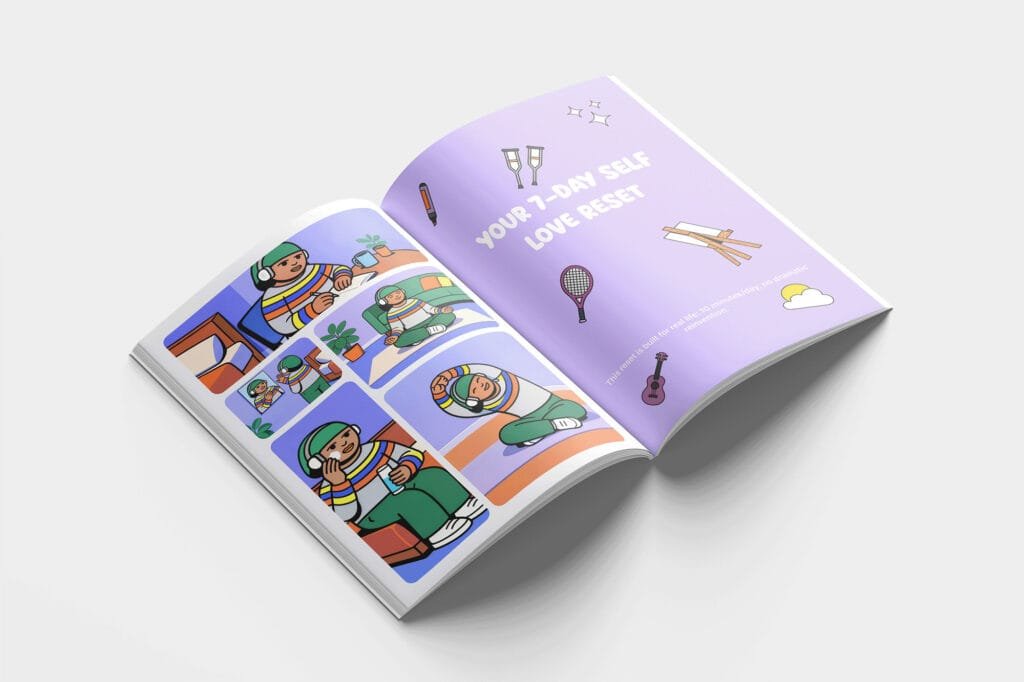
Get your personalized Soft Reset plan in 2 minutes.
Answer a few quick questions and we’ll match you with a gentle plan based on your needs , capacity & vibe so you can feel steadier and build self-trust with small daily steps.
A Simple Self-Check: Am I Caring for Myself or Acting From Ego?
When you’re unsure, you don’t need a 40-minute spiral.
You need a quick, honest pause.
A 10-second checklist
Ask yourself:
- Am I avoiding a hard conversation?
- Am I acting from fear, shame, or resentment?
- Will this choice harm someone unnecessarily?
- Can I communicate clearly and kindly?
- Is there a repair I’m unwilling to make?
If you can communicate clearly and kindly, that’s often a sign you’re in self-love, not ego.
Also helpful: in Nonviolent Communication, Marshall Rosenberg distinguishes between requests and demands partly by how we respond to a “no”, with empathy, or with punishment(we.riseup.net).
That can be a surprisingly grounding lens when you’re setting boundaries.
When repair is needed
Self-love doesn’t mean “I did what I wanted, so nobody can be upset.”
Sometimes the most self-respecting thing you can do is repair:
- “I’m sorry I dropped that on you without warning.”
- “I can see how that hurt. That wasn’t my intention.”
- “I want to renegotiate how we handle this next time.”
Repair doesn’t mean you’re wrong for having needs. It means you’re committed to integrity.
When to seek support
If you’re untangling years of codependent guilt, people-pleasing, conflict avoidance, or chronic self abandonment, it can help to get outside perspective; from therapy, coaching, or a trusted, emotionally mature friend.
Not because you’re broken.
Because you’re learning a new way to live, and new ways often benefit from support.
(And if you’ve ever tried saying no for the first time and felt physically shaky afterward, yes. You’re not alone. – Verywell Mind)

Building a Personal Self-Love Philosophy You Can Trust
Here’s the truth: you don’t need a million rules. You need a few values you can return to when your emotions get loud.
Identify your core values
Choose a handful that feel real to you, like:
- respect
- honesty
- balance
- compassion
- responsibility
- mutuality
- steadiness
Values aren’t there to make you rigid.
They’re there to make you clear.
Create 3–5 “rules” for self-care decisions
Not rules to punish yourself. Rules to protect your sanity.
For example:
- I don’t say yes when I mean no.
- I communicate early instead of exploding late.
- I don’t use boundaries to punish; only to clarify what I will do.
- I choose rest before resentment.
- If my choice hurts someone, I’m willing to repair.
This is integrity and self care working together.
Make it sustainable: consistency beats intensity
You don’t have to become a boundary icon overnight.
Self-love is built through small, repeatable moments:
- one honest no
- one calm request
- one meal
- one night of sleep
- one time you don’t abandon yourself to keep the peace
That’s how self trust building happens.
Not through perfection, but repetition.
How to measure progress
Not by how “unbothered” you seem. Not by how many people you cut off.
A more honest measure is:
- Do I feel more peace in my body?
- Do I feel clearer about what I need?
- Do I trust myself to handle discomfort without collapsing?
- Do my relationships feel more mutual?
If the answer is slowly becoming yes, you’re doing it.
Conclusion
Self-love isn’t selfishness! It’s self-respect in action.
Sometimes it looks like resting. Sometimes it looks like setting a boundary. Sometimes it looks like disappointing someone… and living with that discomfort because the alternative is abandoning yourself.
If you want a practical next step, start here:
Pick one small boundary you’ve been avoiding and practice saying it with kindness.
No speeches. No guilt spiral. Just clarity.
The more you choose self-love with integrity, the less you’ll need ego narratives to defend it and the easier it becomes to show up for others from a full, steady place.